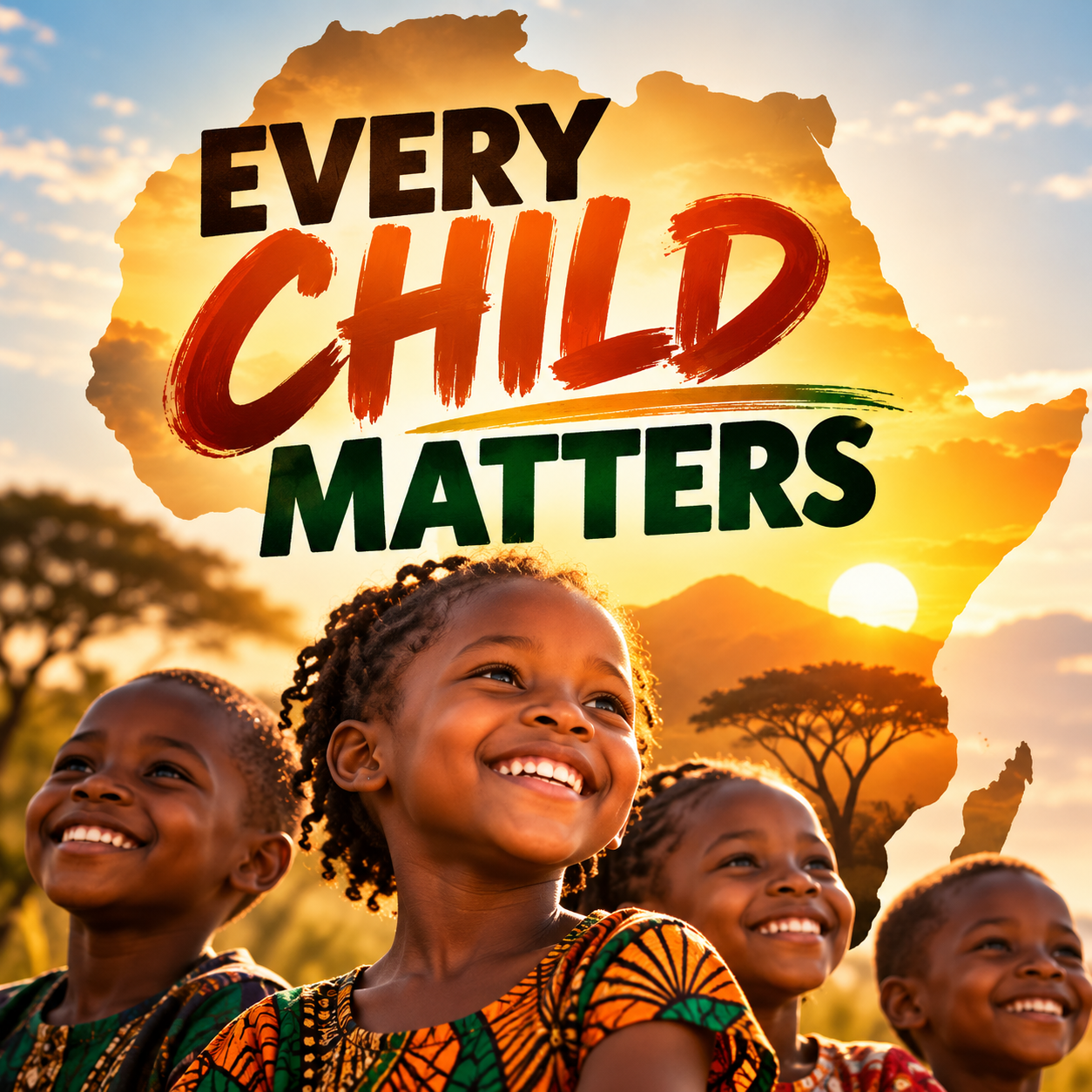
September 30 is observed in Canada as the National Day for Truth and Reconciliation, a day dedicated to honouring Survivors of the residential school system; remembering the children who never returned home, and acknowledging the enduring consequences for their families and communities. "Every Child Matters.”
For AkSES, this message transcends geography; because indeed "Every African Child Matters.
Across parts of Africa, children continue to live under the shadow of armed conflict, terrorism, violent extremism, communal violence, trafficking, displacement and abduction. In some communities, children have been taken from schools, homes, roads and places of worship and held for ransom or subjected to other forms of exploitation.
UNICEF identifies abduction, recruitment, sexual violence, attacks on schools and hospitals, killing and injury among the grave violations affecting children in conflict-affected parts of West and Central Africa.
AkSES recognizes that governments face extraordinarily complex security environments and that many public officials, security personnel, teachers, community leaders and civil society actors are working under difficult circumstances to protect citizens.
This Policy Paper is therefore not an indictment of governments or security institutions. Rather, it is a call for greater urgency, stronger institutions, better coordination, deeper accountability and sustained investment in child protection.
The protection of children must not be treated solely as a security matter. It is a governance obligation, a human-rights obligation, a development obligation and a sustainability obligation.
The African Charter on the Rights and Welfare of the Child already establishes a powerful continental framework. It requires States Parties to make the best interests of the child a primary consideration and specifically requires protection against abuse, neglect and maltreatment, as well as protection and care for children affected by armed conflict.
AkSES therefore calls upon African governments to move from reactive responses to a whole-of-government child-security architecture encompassing prevention, intelligence, safe education, rapid response, law enforcement, justice, victim support, community participation, cross-border cooperation and institutional accountability.
The central message of this paper is simple:
A government that cannot adequately protect its children must regard child security as an urgent governance priority.
Africa's children are not merely the citizens of tomorrow. They are citizens today, entitled to safety, dignity, education, family, opportunity and protection.
2. The Significance of September 30
The National Day for Truth and Reconciliation in Canada provides an opportunity to reflect upon a painful chapter in the country's history involving the removal of Indigenous children from their families and communities through the residential school system. The Canadian government describes September 30 as a day to honour Survivors and the children who never returned home, their families and communities, and to deepen public understanding of the lasting impacts of the residential school system.
The orange shirt has consequently become a symbol of remembrance and the affirmation that "Every Child Matters".
AkSES approaches this observance with respect for its specific Canadian historical and Indigenous context.
Africa's circumstances are different, and the continent must not simply transplant another society's historical experience onto its own.
Nevertheless, there is a universal human principle embedded within the message:
No child should disappear into the machinery of violence, exploitation, institutional failure or indifference.
That principle is profoundly relevant to Africa.
Where children are abducted from their homes, kidnapped on highways, taken from schools, recruited by armed groups, trafficked, sexually exploited or displaced by conflict, the question is not simply whether the perpetrators can be apprehended.
The deeper governance question is:
What institutional arrangements are necessary to ensure that children are protected before harm occurs?
3. Africa's Children and the Crisis of Insecurity
Africa is a continent of extraordinary youthful energy and demographic potential. Yet children in conflict-affected and fragile environments can experience a radically different reality.
UNICEF reports that children in West and Central Africa affected by armed conflict face grave violations including killing and injury, recruitment by armed forces or armed groups, sexual violence, abduction, denial of humanitarian assistance and attacks on schools and hospitals.
UNICEF's regional assessment has also highlighted the scale of humanitarian need among children in West and Central Africa, driven in significant part by conflict and other crises.
The challenge therefore extends beyond terrorism in its narrow sense.
Child insecurity can emerge from an interconnected ecosystem involving:
* terrorism and violent extremism;
* organized criminal networks;
* kidnapping and ransom economies;
* trafficking in persons;
* communal and political violence;
* armed conflict;
* displacement;
* porous borders;
* weak policing capacity;
* inadequate intelligence coordination;
* corruption;
* poverty and exclusion;
* unsafe transportation corridors;
* inadequate protection around schools;
* weak emergency-response systems; and
* limited access to justice.
These problems cannot be addressed by military force alone.
Human security requires human-centred governance.
4. The African Child Already Has a Continental Rights Framework
Africa does not lack a normative framework for protecting its children.
The African Charter on the Rights and Welfare of the Child, adopted in 1990 and entering into force in 1999, provides an important continental foundation for child protection.
Article 4 establishes that: “In all actions concerning the child ... the best interests of the child shall be the primary consideration.
The Charter further requires States to protect children from abuse, neglect and maltreatment and to establish mechanisms for prevention, identification, reporting, investigation, treatment and follow-up of child abuse.
Most significantly for conflict-affected environments, Article 22 requires States to protect children affected by armed conflict and to take measures to ensure their protection and care.
Thus, the question before African governments is not whether there is a continental principle supporting child protection.
There is.
The continuing challenge is translating legal commitments into effective institutions, adequate budgets, preventive systems and measurable protection on the ground.
5. Child Protection Is a Governance Issue
AkSES believes that the protection of children must be incorporated into the definition of good governance.
Good governance is not merely about elections, public administration, infrastructure or economic management.
It is also about whether institutions:
* protect life;
* uphold the rule of law;
* respond to citizens in distress;
* prevent foreseeable harm;
* use public resources responsibly;
* coordinate effectively;
* investigate wrongdoing;
* hold perpetrators accountable;
* support victims;
* communicate honestly with citizens; and
* continuously learn from institutional failures.
The United Nations' Sustainable Development Goal 16 explicitly connects peaceful societies, access to justice and effective, accountable institutions. Its Target 16.2 calls for an end to abuse, exploitation, trafficking and all forms of violence against and torture of children.
This establishes an important policy connection:
Child protection → human security → rule of law → accountable institutions → sustainable development.
Consequently, protecting children is not peripheral to development.
It is development.
6. From Reaction to Prevention
One of the most important governance shifts required is a movement from reactive security to preventive security.
Governments frequently become highly visible after an abduction has occurred: security forces are mobilized, search operations begin, negotiations may commence, and political statements are issued.
But good governance asks a prior question:
What could have been done before the child disappeared?
Prevention should therefore include:
a. Risk mapping of vulnerable communities and transportation corridors;
b. Early-warning systems involving communities, schools and security agencies;
c. School protection plans, particularly in high-risk areas;
d. Rapid emergency communication systems;
e. Improved intelligence-sharing among relevant agencies;
f. Protection of major roads and transit corridors;
g.Community-based security partnerships;
h. Cross-border information-sharing;
I. Child-sensitive policing; and
j. Regular public assessment of child-security risks.
The objective should be to make the disappearance of a child an institutional emergency, not simply a private family tragedy.
7. Schools Must Be Places of Learning, Not Places of Fear
Education is one of Africa's greatest investments in human capital.
A child should be able to leave home for school with the reasonable expectation of returning safely.
Where insecurity causes parents to fear sending children to school, terrorism and criminality achieve something beyond the immediate crime: they undermine education, social mobility, human capital formation and community confidence.
The protection of schools should therefore be incorporated into national security and development planning.
Governments should strengthen:
* security risk assessments around vulnerable schools;
* emergency communication mechanisms;
* safe transportation arrangements;
* teacher and school-community protection networks;
* emergency evacuation protocols;
* psychosocial support;
* rapid response to threats;
* intelligence gathering around schools; and
* continuity-of-learning arrangements when displacement occurs.
UNICEF notes that children affected by armed conflict can experience attacks on schools and other grave violations.
For learning to be meaningful, for environments to be sustainable and for developments to be sustainable; vulnerable groups especially children must be able to leave home for school and errands and must return home safely.
Geoffrey Obinna Anoliefo
AkSES