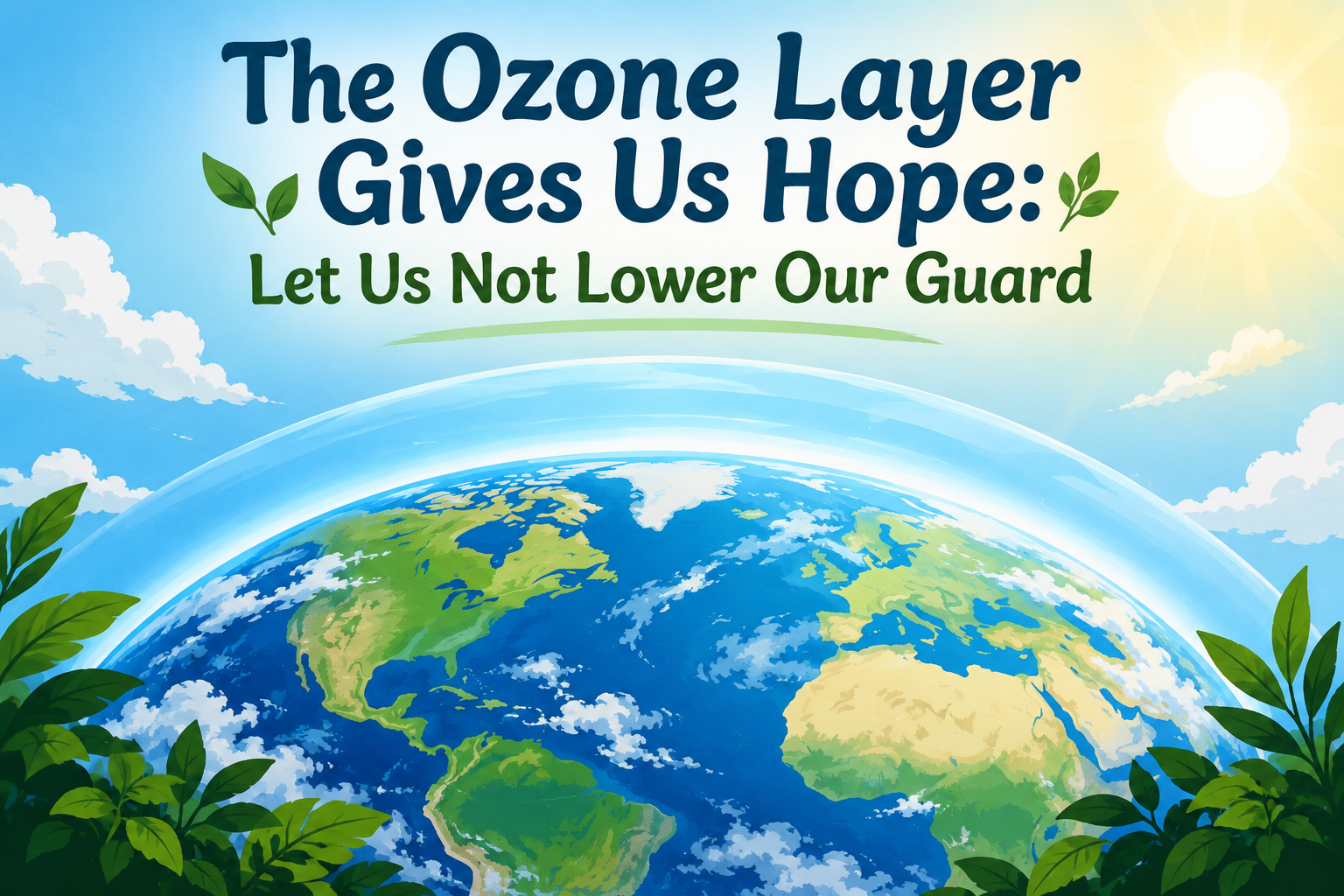
Introduction: A Journey That Became an Environmental Observation
The 16th of September is a day on which humanity is reminded of one of its most remarkable environmental achievements; the international effort to protect the Earth's ozone layer.
For AkSES, however, September 16 should not merely be a day of celebration. It should also be a moment for reflection, renewed vigilance and a reaffirmation of our collective responsibility towards "Our Common Home"-Mother Earth, Mother Africa.
Over the past several years, I have had the unusual privilege of travelling extensively by road and rail across different parts of Africa, Europe and North America. My journeys have taken me from Calabar in Nigeria to Abidjan in Côte d'Ivoire; from Kitwe in Zambia to the Kasumbalesa in Congo DR; from Kalamata to Athens in Greece; and vastly from Vancouver, to Seattle in North America; and also from Halifax in Nova Scotia through St. Andrews, Fredericton and Woodstock in New Brunswick, to Bangor, Maine, Boston, New York and Washington, D.C.
I deliberately travelled by road and rail wherever possible, allowing opportunities to make observational stops along the way.
What remained particularly striking was the presence of extensive forests and tree-covered landscapes: the surviving primary and secondary forests of Africa, and the substantial pine, boreal, temperate and other forests encountered across Europe and North America.
These observations are not presented as a substitute for scientific measurement. Rather, they provide a personal reminder of something fundamental: when nature is protected, given space to regenerate, and supported by appropriate institutions and human stewardship, nature possesses a remarkable capacity for recovery.
That same lesson is powerfully illustrated by the ozone layer.
1. The Ozone Story: A Triumph of Science, Cooperation and Governance
The story of ozone protection is one of the clearest demonstrations that humanity can recognize an environmental danger, mobilize science, negotiate internationally, establish enforceable rules and achieve measurable environmental recovery.
The discovery of severe depletion of stratospheric ozone, particularly over Antarctica, led to the Vienna Convention for the Protection of the Ozone Layer (1985), and subsequently to the Montreal Protocol on Substances that Deplete the Ozone Layer (1987).
The Montreal Protocol and its amendments progressively controlled and phased out ozone-depleting substances such as chlorofluorocarbons (CFCs), halons and other chemicals responsible for stratospheric ozone destruction.
The United Nations Environment Programme's Ozone Secretariat describes the Protocol as having successfully met its objectives thus far and says that the ozone layer is well on its way to recovery.
This achievement did not happen by accident.
It resulted from the convergence of:
* scientific research and monitoring;
* international cooperation;
* binding international agreements;
* national legislation and implementation;
* technological innovation;
* financial and technical assistance to developing countries;
* continuous scientific assessment;
* monitoring and reporting; and
* sustained political commitment.
The ozone story therefore represents much more than atmospheric chemistry. It is a story about the power of good environmental governance.
2. The Good News: The Ozone Layer Is Showing Signs of Recovery
The latest evidence provides legitimate grounds for optimism.
The World Meteorological Organization's September 2026 Ozone and UV Bulletin reports that the 2025 Antarctic ozone hole was one of the smallest in recent decades. Its ozone mass deficit was more than 25 percent below the 1990–2010 average, placing the 2025 ozone hole among the least severe since the period of severe depletion began. WMO nevertheless emphasizes that annual fluctuations occur and that continued monitoring and policy action remain essential.
The scientific evidence accumulated over recent decades has established a broad recovery trend following the reduction of ozone-depleting substances.
The 2022 WMO/UNEP assessment projected that, if existing policies remained in place, ozone would return approximately to 1980 levels by around:
* 2040 for most of the world;
* 2045 over the Arctic; and
* 2066 over Antarctica.
Importantly, the 2026 WMO/UNEP Scientific Assessment of Ozone Depletion is presently being finalized, with hundreds of international scientists contributing to the assessment. Its scope includes ozone-depleting substances, HFCs, global and polar ozone, and the interaction between stratospheric ozone and climate change.
Recent peer-reviewed research also reports evidence of ozone recovery in parts of the Arctic, although Arctic recovery is complicated by considerable natural variability and by interactions within the changing climate system.
AkSES therefore joins the global environmental community in welcoming the evidence of recovery; but with optimism tempered by vigilance.
3. The Montreal Protocol: A Model We Must Not Abandon
The lesson from the ozone experience is particularly important for today's climate and environmental challenges.
The international community acted because governments accepted scientific evidence, established common rules and continued to monitor compliance.
The Kigali Amendment to the Montreal Protocol, adopted in 2016, extended this environmental cooperation into the climate arena by providing for the phase-down of hydrofluorocarbons (HFCs), many of which are powerful greenhouse gases used as substitutes for ozone-depleting substances.
WMO reports that the Kigali Amendment is expected, if fully implemented, to avoid up to approximately 0.5°C of global warming by the end of the century.
This demonstrates an important principle:
Environmental treaties can work when science, political will, technology, finance, law and international cooperation work together.
The success of Montreal should therefore encourage, not discourage stronger international action on greenhouse gases, climate change, land degradation, biodiversity loss and pollution.
4. But Let Us Not Mistake Ozone Recovery for Environmental Recovery
AkSES celebrates the progress on ozone while sounding a note of caution.
The recovery of the ozone layer does not mean that the environmental crisis is over.
Ozone depletion and climate change are scientifically interconnected but distinct environmental problems.
The Montreal Protocol successfully addressed a specific class of chemicals responsible for ozone depletion. The world must now continue addressing the much broader accumulation of greenhouse gases, deforestation, land degradation, biodiversity loss, pollution and unsustainable resource exploitation.
Indeed, the 2026 ozone assessment process itself recognizes the interaction between stratospheric ozone and the climate system.
The message is therefore simple:
Let us celebrate the success without becoming complacent.
5. Our Forests: Nature's Living Infrastructure
My observations across Africa, Europe and North America have reinforced another important lesson.
Forests are not merely collections of trees.
They are living infrastructure.
They regulate water cycles, protect soils, store carbon, support biodiversity, moderate local climates, provide livelihoods and contribute to human health and well-being.
The FAO Global Forest Resources Assessment 2025 reports that forests cover approximately 4.14 billion hectares, about 32 percent of the world's land area. It also reports that the rate of net forest loss has declined substantially from approximately 10.7 million hectares annually during the 1990s to about 4.12 million hectares annually during 2015–2025.
These figures provide grounds for encouragement.
But the same assessment makes clear that forests remain under considerable pressure. Africa continues to experience relatively significant forest loss, and global forest expansion has itself slowed.
Consequently, forest recovery in some regions must not become an excuse for complacency elsewhere.
Africa's remaining primary forests in particular represent an irreplaceable ecological inheritance.
They should not be viewed merely as reservoirs of timber waiting for economic exploitation.
They are part of Africa's natural capital, ecological heritage and intergenerational inheritance.
6. Reforestation Must Become Restoration
AkSES therefore calls for a conceptual shift:
From tree planting to ecosystem restoration.
Planting trees is valuable, but planting trees cannot automatically replace the ecological functions of an intact natural forest.
The United Nations Decade on Ecosystem Restoration 2021–2030, led by UNEP and FAO, seeks to prevent, halt and reverse ecosystem degradation worldwide. UNEP notes that restoration includes both actively restoring degraded ecosystems and conserving ecosystems that remain intact.
The UN framework has also identified the restoration of hundreds of millions of hectares of degraded terrestrial and aquatic ecosystems as a major global opportunity.
According to UNEP, restoration of 350 million hectares by 2030 could generate substantial ecosystem services and potentially remove 13–26 gigatonnes of greenhouse gases from the atmosphere.
For Africa, restoration should include:
* protection of remaining primary forests;
* restoration of degraded forests;
* agroforestry;
* mangrove restoration;
* watershed rehabilitation;
* restoration of wetlands;
* sustainable rangeland management;
* protection of indigenous tree species;
community-based forest management;
* prevention of uncontrolled bush burning;
* sustainable charcoal and fuelwood strategies;
* restoration of degraded agricultural soils; and
* protection of biodiversity corridors.
The objective must be ecological integrity, not merely the number of seedlings planted.
7. The UN Must Remain a Voice for Stronger Climate Action
AkSES calls upon the United Nations and its specialized agencies to continue providing strong scientific leadership and advocacy for the reduction of greenhouse-gas emissions.
The scientific case for sustained climate action remains compelling.
The UNFCCC has emphasized that continued greenhouse-gas emissions lead to continued warming and that carbon dioxide remains in the atmosphere for long periods. Land and ocean ecosystems currently absorb a substantial proportion of human-produced CO₂, making the integrity of forests, soils, wetlands and oceans an important component of climate stability.
Accordingly, the international community should continue to pursue:
1. deep reductions in greenhouse-gas emissions;
2. accelerated transition toward clean and renewable energy;
3. improved energy efficiency;
4. protection and restoration of forests and other carbon-rich ecosystems;
5. climate-resilient agriculture;
6. sustainable transportation;
7. reduction of methane and other short-lived climate pollutants;
8. circular approaches to production and consumption;
9. climate finance and technology transfer for developing countries; and
10. stronger implementation and accountability under the Paris Agreement.
The lesson of Montreal is that international environmental agreements must not merely be signed, they must be implemented, monitored and continually strengthened.
8. Africa Must Protect What It Still Possesses
Africa occupies a special position in this global environmental conversation.
The continent still possesses enormous ecological wealth, including tropical forests, savannahs, wetlands, mountains, mangroves, grasslands, freshwater systems and vast biodiversity.
But Africa also faces profound pressures from poverty, energy insecurity, agricultural expansion, illegal logging, mining, urbanization, conflict, land degradation and climate change.
The answer cannot be to choose between development and environmental protection.
Africa needs sustainable development; devevelopment that creates economic opportunity while preserving the ecological foundations upon which future prosperity depends.
This is precisely where "good governance" becomes an environmental instrument.
9. Good Governance Is Environmental Protection
AkSES has consistently maintained that environmental sustainability cannot be separated from governance.
Where environmental laws are strong but poorly enforced, degradation continues.
Where forests are legally protected but illegal exploitation goes unpunished, protection becomes largely symbolic.
Where land-use planning is weak, development can destroy watersheds, forests and agricultural ecosystems.
Where corruption undermines environmental institutions, natural resources become vulnerable to unsustainable exploitation.
Where communities are excluded from decisions concerning their natural resources, conservation can become difficult to sustain.
Therefore:
Good governance is climate action.
It means:
* credible environmental 6institutions;
* transparent resource management;
* enforcement of environmental laws;
* accountable public officials;
* science-based environmental policy;
* meaningful community participation;
* responsible private-sector conduct;
* long-term land-use planning;
* environmental impact assessment;
* reliable environmental data; and
* intergenerational responsibility.
The ozone experience teaches us that rules matter-but institutions that enforce those rules matter even more.
10. AkSES Position
In light of the foregoing, the AkSES:
1. Welcomes the continuing evidence of ozone-layer recovery and recognizes the Montreal Protocol, the Vienna Convention, the Kigali Amendment, scientific monitoring and international cooperation as landmark achievements in global environmental governance.
2. Calls upon nations not to rest on their oars
The progress achieved in ozone protection must be protected through continued compliance, monitoring, enforcement, technological innovation and scientific research.
3. Calls for accelerated ecosystem restoration
Governments, communities, businesses and civil society should intensify efforts to protect existing forests and restore degraded ecosystems.
4. Calls for special protection of Africa's remaining natural forests
Africa's primary forests should be treated as ecological assets of global significance and as part of the continent's natural inheritance.
5. Urges the United Nations to maintain strong advocacy for greenhouse-gas reduction.
The international community must continue to reduce emissions while strengthening adaptation, resilience, climate finance and nature-based solutions.
6. Calls for the implementation of the UN Decade on Ecosystem Restoration.
The restoration agenda should move from international declarations to measurable action at national, regional and community levels.
7. Calls for stronger environmental governance
Environmental sustainability must be integrated into development planning, public finance, infrastructure, agriculture, energy, mining, transportation and urban development.
8. Encourages African governments to embrace indigenous and locally appropriate environmental knowledge.
Traditional ecological knowledge and indigenous resource-management practices should be respectfully examined, scientifically evaluated where appropriate, and integrated with modern environmental science.
9. Reaffirms the centrality of good governance.
Environmental sustainability cannot be secured without transparency, accountability, rule of law, institutional capacity and responsible stewardship of natural resources.
10. Commits AkSES to intensified advocacy.
AkSES will continue to use research, public lectures, symposia, partnerships, public education and evidence-based advocacy to advance:
Environmental Sustainability + Good Governance + Responsible Resource Management + African Cultural Renaissance = Sustainable Development.
11. From Ozone to Our Common Home
The ozone story gives humanity something that is desperately needed in the wider environmental debate:
Hope grounded in evidence.
Humanity damaged the ozone layer.
Humanity recognized the damage.
Science revealed the causes.
Nations negotiated.
Governments legislated.
Industry innovated.
Institutions monitored.
And the atmosphere began to respond.
That experience should give us confidence that environmental decline is not always irreversible.
But it also teaches us that recovery requires persistence.
The same principle applies to forests, soils, rivers, wetlands, biodiversity and the climate system.
The green 6landscapes encountered during my journeys across Africa and the northern hemisphere have therefore become, for me, more than beautiful scenery. They are reminders of what the Earth can still offer humanity when nature is allowed to live, regenerate and flourish.
But what we see today must not be taken for granted.
*A forest standing today must be protected so that it may still be standing tomorrow.
A river flowing today must be protected so that another generation may drink from it.
A healthy atmosphere today must be protected so that our children and grandchildren may inherit it.
And the ozone layer recovering today must remind us that collective action works but only when humanity remains committed to the work.
Conclusion: Hope, Vigilance and Responsibility
As the world moves beyond September 16, AkSES calls for neither environmental pessimism nor complacency.
We choose informed hope.
The ozone layer demonstrates what science, international cooperation and good governance can achieve.
The world's forests demonstrate both the resilience of nature and the consequences of failing to protect it.
The climate crisis reminds us that environmental progress in one area cannot compensate for inaction in another.
Our responsibility, therefore, is clear:
Protect what remains.
Restore what has been degraded.
Reduce what we emit.
Govern what we possess responsibly.
And leave Our Common Home healthier for generations yet unborn.
AkSES will continue to intensify its advocacy for
Environmental Sustainability, Good Governance and responsible stewardship of Africa's natural resources, working across the boundaries of science, culture, governance, academia and community action.
The recovery of the ozone layer gives us reason to hope.
Let that hope become action.
Let that action become policy.**
Let that policy be governed by integrity.
And let our collective stewardship ensure that Mother Earth-Mother Africa-remains a habitable and flourishing home for generations to come.
Obi Anoliefo
AkSES