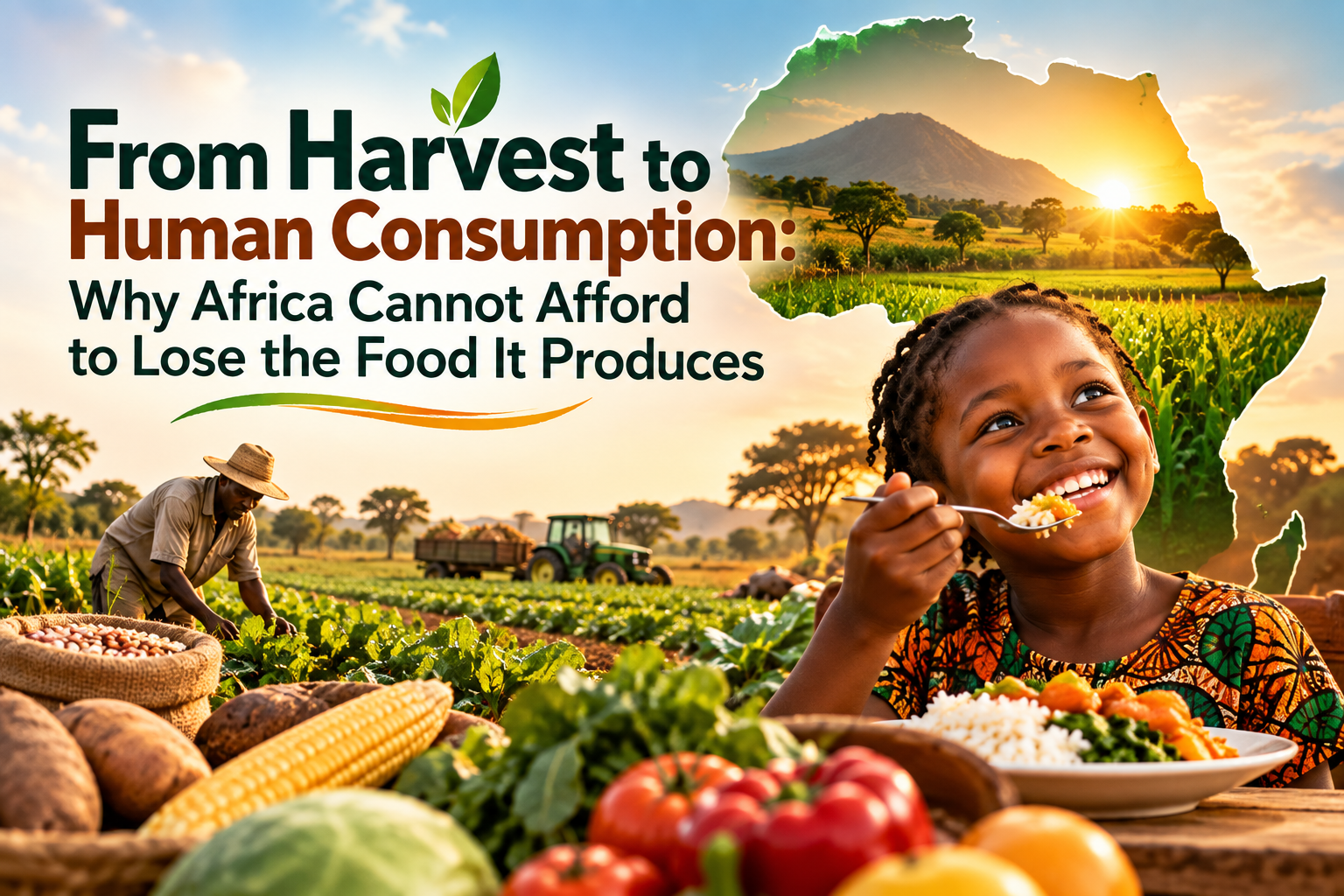
From Harvest to Human Consumption: Why Africa Cannot Afford to Lose the Food It Produces
Africa confronts a profound food-system paradox.
At a time when more than 306 million Africans were said to be undernourished in 2024, almost 59% of the continent's population experienced moderate or severe food insecurity, and more than one billion people could not afford a healthy diet, substantial quantities of food continue to be lost or wasted along African food value chains. We cannot live close to the river and wash our faces with spittle.
The paradox is not simply that Africa produces too little food. It is also that too much of what Africa produces fails to reach consumers in usable, affordable and timely form.
Food may be lost because:
i. It cannot be transported from farms to markets.
ii. Storage facilities are inadequate
iii. electricity and refrigeration are unreliable.
iv. Processing capacity is insufficient.
v. Climate shocks destroy or damage crops.
vi. Producers are disconnected from viable markets.
Food waste also occurs later in the chain, including in households, food service and retail. Yet the evidence base for these stages remains particularly weak in many African countries. UNEP's 2024 Food Waste Index identified household food-waste data from only Sub-Saharan African countries and three North African countries, with very limited comparable data for food service and retail.
This evidence gap is itself a governance concern.
AkSES position is that food loss and waste in Africa should be treated not merely as an agricultural, environmental or behavioural problem, but as a governance and institutional challenge.
Governance determines whether;
a. Rural roads are built and maintained;
b. Farmers can access storage and processing;
c. Energy systems support cold chains;
d. Markets function efficiently;
e. Regional trade barriers impede the movement of food;
f. Climate risks are aticipated; and
g. Public institutions coordinate effectively across the food system. Food is sacred, waste is imprudent, and everything provided should be valued.
Reducing food loss and waste is therefore not simply about saving food. It is about protecting farmer incomes, strengthening food security, reducing poverty, creating economic value, improving climate resilience and making African institutions work better for African people.
1. The African Food Paradox
The latest evidence makes the urgency unmistakable.
In 2024;
* More than 306 million people in Africa were undernourished, representing more than 45% of the global total.
* 20.2% of Africa's population was undernourished
* Almost 892.7 million Africans experienced moderate or severe food insecurity.
* Almost 337 million experienced severe food insecurity.
* More than one billion Africans were unable to afford a healthy diet.
Against this backdrop, food that is produced but never eaten represents more than an economic inefficiency. Our elders say that an already cooked food is nearly same as excreta.
The above statistics represent a lost opportunity to feed people, improve farmer incomes, create employment and reduce pressure on land, water and energy.
The African question should therefore move beyond:
A. How do we produce more food, and increasingly ask:
B. How do we ensure that more of the food we produce reaches people safely, affordably and efficiently? Our people ask, "by the time the blind man finishes eating the ripe cherry fruit he luckily stepped on, how does he hope for more?
The worry above is fundamentally a food-systems question.
And food systems are governed.
2. Food Loss Is not the Same as Food Waste
A credible African policy response must distinguish between food loss and food waste.
Food loss generally occurs between production and retail; for example during harvesting, handling, storage, transportation and processing.
Food waste occurs primarily at retail, food-service and household stages.
Globally, FAO currently estimates that 13.2% of food is lost after harvest and before retail, while UNEP's 2024 evidence indicates that a further 19% is wasted at retail, food-service and household levels. These global figures should not be mechanically applied to every African country or commodity.
Africa's evidence base is considerably more fragmented.
FAO's Food Loss and Waste Database had, by January 2026, assembled almost 40,000 data points from 167 countries, covering 296 commodities and commodity groups. Yet FAO also emphasises that the underlying data come from diverse sources and require contextual interpretation.
This is important.
AkSES does not advocate replacing one simplistic statistic with another.
Africa needs reliable country-, commodity- and value-chain-specific measurement.
The absence of adequate data should not, however, become an excuse for institutional inaction.
3. The Governance Gap
AkSES places food loss and waste within the broader framework of good governance.
Why?
Because many of the conditions that cause avoidable losses are not controlled by individual farmers or consumers.
A farmer cannot build a rural road.
A smallholder cannot establish a national electricity grid.
A market trader cannot construct a regional cold chain.
A household cannot redesign agricultural trade policy.
A small processor cannot single-handedly solve systemic financing constraints.
Yet each of these institutional conditions can determine whether food reaches the consumer or becomes a loss.
Food loss therefore provides a revealing lens through which to examine institutional effectiveness.
4. Five Governance Failures That Feed Food Loss
4.1 Poor Transport and Rural Infrastructure
Farmers can produce food successfully and still lose economically if they cannot reach markets.
Poor feeder roads, inadequate bridges, high transport costs and inefficient logistics increase the time and cost required to move food from farms to consumers.
For highly perishable commodities, delays can translate directly into physical losses.
The African Development Bank has long identified inadequate transport, storage, processing facilities and market connectivity as significant constraints on agricultural development and post-harvest outcomes.
The policy implication is clear:
Rural infrastructure is food-security infrastructure.
Roads leading to productive agricultural communities should not be treated as peripheral infrastructure.
5. Cold Chains, Energy and Storage
Perishable foods require appropriate temperature management.
Yet many African food systems continue to operate with limited cold-storage and temperature-controlled logistics.
This is not simply a technology problem.
It is also a question of:
* electricity access and reliability;
* investment;
* financing;
* infrastructure planning;
* maintenance;
* market organisation;
* technical skills; and
* public-private coordination.
There are promising African examples.
The African Development Bank supported the development of a regional cold-chain investment facility intended to establish temperature-controlled storage and distribution infrastructure in Kenya, Tanzania, Ethiopia, Uganda and Rwanda.
Such initiatives demonstrate that the cold-chain challenge can be addressed through investment and institutional coordination.
The question is how to take successful approaches to scale.
6. Climate Shocks: From Emergency Response to Resilience
Climate change is intensifying the risks facing African food systems.
Drought, flooding, extreme temperatures, pests and other environmental shocks can damage crops directly.
But climate shocks also expose weaknesses in transportation, storage, processing and markets.
The World Bank reported in 2026 that partial crop losses in Nigeria increased from approximately 6% of plots in 2018/19 to more than 20% in 2023/24, with climate shocks, environmental stress and insecurity among the identified drivers.
This demonstrates why climate resilience cannot stop at the farm gate.
Africa requires resilient food systems, encompassing:
* climate information;
* early-warning systems;
* resilient rural infrastructure;
* irrigation and water management;
* appropriate storage;
* insurance and risk-financing mechanisms;
* processing capacity; and
* emergency logistics.
Good governance means anticipating foreseeable risks rather than repeatedly paying the cost of avoidable crises.
7. Market Inefficiencies
Food loss is frequently an economic problem before it becomes a physical one.
When farmers cannot identify buyers, when prices collapse during seasonal gluts, when transport costs are prohibitive or when markets are poorly integrated, farmers may have little incentive or ability to preserve and market their produce.
The World Bank's review of post-harvest losses in Sub-Saharan Africa found that reported maize losses vary substantially and are influenced by factors including temperature, humidity, market access and storage practices.
The lesson is important:
Food-loss policy must address markets, not merely storage technologies.
Better roads and warehouses are insufficient if farmers still cannot connect efficiently to profitable markets.
8. Processing Capacity: The Missing Link
One of Africa's greatest opportunities is to turn food that is currently highly perishable into products with longer shelf lives and greater economic value.
Processing can:
* reduce seasonal losses;
* stabilise food availability;
* create jobs;
* increase farmer incomes;
* support women and youth enterprises;
* strengthen local industries; and
* reduce dependence on imported processed food.
Nigeria provides a particularly instructive example.
Nigeria is a major tomato producer, yet FAO reported in 2025 that more than 50% of the country's annual tomato yield was being lost, citing seasonal gluts, inadequate production practices and high perishability among the challenges. FAO and Kaduna State consequently launched a programme focused on improved storage and processing infrastructure, farmer organisations and post-harvest-loss reduction.
In February 2026, FAO further reported the introduction of solar-powered slab dryers in Kaduna State to replace traditional ground sun-drying practices and improve tomato processing and food safety.
This is the kind of practical, context-specific intervention that should inform broader African policy.
9. Country Example: Rwanda and the Value of Measurement
Rwanda offers another useful lesson, not because its experience can simply be transplanted elsewhere, but because it demonstrates the value of measuring losses by commodity.
The African Development Bank's Rwanda Food Balance Sheets report estimated an average food-loss percentage of 4.7% for a selected basket of commodities between 2017 and 2021. The report also identified improvements in post-harvest handling of maize, beans and rice during the period.
The important lesson for AkSES is methodological:
Policy should be based on what is measured rather than on assumptions about what is lost.
Different commodities require different interventions.
Grain storage is not tomato storage.
Milk is not cassava.
Fish is not maize.
A serious African strategy must therefore be commodity-specific, location-sensitive and evidence-driven.
10. Country Example: Kenya and Institutional Coordination
Kenya provides another important governance example.
According to FAO, Kenya developed a dedicated national strategy addressing food loss and waste in 2024, following consultations involving government ministries, the private sector and civil society.
The strategy focuses on post-harvest management, food safety and public-private partnerships, while recognising the role of county governments in implementation and monitoring.
This illustrates a principle AkSES strongly supports:
Food-loss reduction requires coordination across levels of government and across sectors.
National ministries cannot deliver the entire solution alone.
Implementation frequently occurs where farmers, traders, processors, local governments and consumers actually interact.
11. Food Waste: The Urban and Household Dimension
Food loss should not obscure food waste.
As Africa urbanises and consumer markets expand, waste occurring at household, hospitality, retail and food-service levels deserves increasing policy attention.
UNEP's 2024 Food Waste Index found that Africa's evidence remains incomplete. It identified household data from 14 Sub-Saharan African countries, but only one country with usable food-service data and two with retail data in its regional dataset.
This means Africa needs better measurement before making sweeping claims about the relative scale of household, retail and food-service waste.
However, the policy direction is clear:
What is not measured cannot be effectively managed.
Governments should incorporate food-waste measurement into national statistics, municipal waste systems and food-system planning.
12. AkSES Position
AkSES position is that persistent food loss and waste should be understood as a governance challenge embedded within Africa's wider food-system transformation agenda.
This does not mean assigning blame exclusively to governments.
Farmers, traders, processors, retailers, hospitality businesses, households and consumers all have responsibilities.
But the institutional environment within which they operate matters enormously.
Good governance means:
* policies that are coherent;
* institutions that coordinate;
* infrastructure that functions;
* markets that connect producers to consumers;
* public investment that delivers measurable outcomes;
* regulations that support responsible enterprise;
* data that informs decisions; and
* institutions that can be held accountable.
The objective should not merely be to tell Africans to waste less.
The objective should be to build food systems in which less food becomes vulnerable to loss in the first place.
13. AkSES Policy Recommendations
1. Make Food Loss Reduction a National Food-Security Priority
African governments should integrate food-loss reduction into national food-security, agricultural, industrial, trade and climate strategies.
2. Treat Rural Infrastructure as Food Infrastructure
Investment in feeder roads, bridges, electricity, water, storage and digital connectivity should be prioritised according to agricultural production zones and food corridors.
3. Build Africa's Cold-Chain Economy
Governments should create incentives for private investment in affordable, energy-efficient and decentralised cold-storage and refrigerated transport.
4. Expand Local Processing
African countries should promote appropriate processing capacity near major production centres, particularly for highly perishable commodities.
5. Strengthen Farmer-to-Market Connections
Producer organisations, aggregation centres, digital market platforms, logistics providers and transparent market-information systems should be strengthened.
6. Make Climate Resilience a Whole-Chain Responsibility
Climate adaptation should encompass farms, roads, storage, energy, processing, markets and emergency distribution systems.
7. Measure Before Designing One-Size-Fits-All Solutions
Governments should establish commodity- and value-chain-specific baselines for food loss and waste.
8. Strengthen Local Government Capacity
Local government councils, state, provincial and municipal authorities should have the resources and institutional mandates required to implement food-loss and waste strategies.
9. Mobilise Private Capital
Food-loss reduction should be developed as an investment opportunity in logistics, cold chains, processing, packaging, digital agriculture and circular-economy enterprises.
10. Strengthen African Regional Food Markets
The African Continental Free Trade Area and regional economic communities provide opportunities to improve the movement of food across borders, reduce bottlenecks and connect areas of surplus with areas of deficit.
Food should be able to move efficiently across Africa.
14. A Proposed AkSES Governance Framework
AkSES proposes a simple framework for African policymakers:
PRODUCE → PRESERVE → PROCESS → MOVE → MARKET → CONSUME → RECOVER
At every stage, governments and stakeholders should ask:
Who is responsible?
What infrastructure is required?
What institutional barrier exists?
What data do we have?
What outcome should be measured?
Who is accountable?
This converts food-loss reduction from a broad aspiration into a governance programme.
Thank you.
Geoffrey Obinna Anoliefo, Ph.D
AkSES