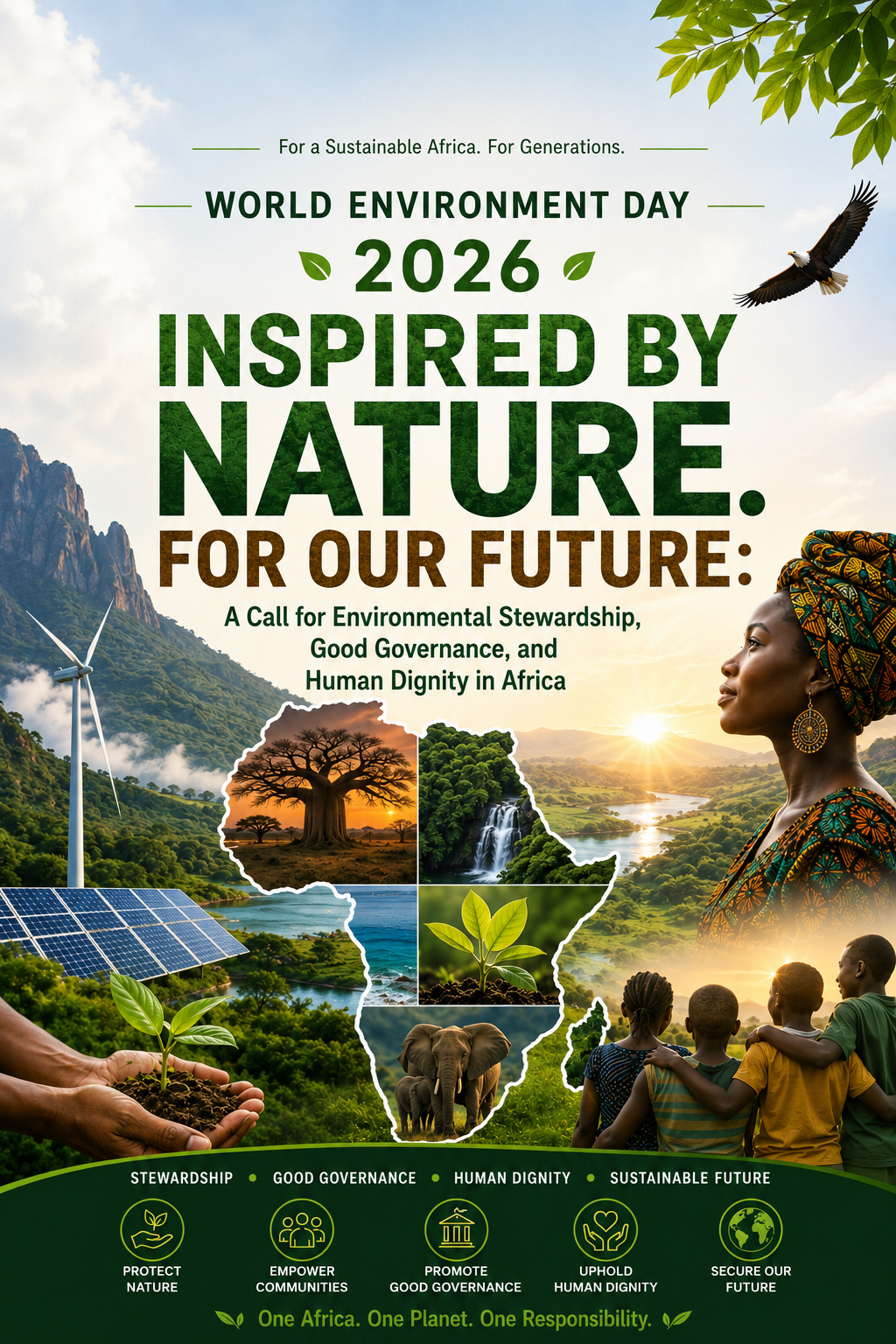
On this World Environment Day, June 5, 2026, humanity is reminded of a profound truth embodied in this year's theme: "Inspired by Nature. For Our Future." It is both a celebration and a warning; a celebration of the resilience and beauty of nature, and a warning that the Earth is sending increasingly urgent signals that can no longer be ignored.
Across the globe, we are witnessing unprecedented heatwaves, devastating wildfires, prolonged droughts, flooding, desertification, biodiversity loss, and rising sea levels. These are not isolated environmental events; they are symptoms of a deeper imbalance in humanity's relationship with nature. Mother Earth is speaking. The question before us is whether we are willing to listen and act. Our elders warn that “the grasshopper that gets killed by the noisy bird must be hard of hearing” and “the stubborn house fly usually gets buried with the corpse”.
Alkebulan Society for Environmental Sustainability (AkSES), believes that environmental sustainability cannot be separated from good governance, social justice, and responsible leadership. The environment is not merely about forests, rivers, wildlife, and climate. It is fundamentally about people; their health, dignity, security, and future.
The African Environmental Governance Challenge: Africa is blessed with immense natural wealth. The continent possesses some of the world's richest deposits of minerals, vast forests, fertile agricultural lands, abundant water resources, and remarkable biodiversity. Yet, paradoxically, many African communities remain among the poorest and most vulnerable populations on Earth. Our elders have always wondered why “one would be by the river and yet washes one’s face with saliva”. The tragedy is not the absence of resources but often the absence of responsible stewardship.
In many regions, natural resources are exploited with little regard for sustainability, accountability, or the welfare of local populations. Forests are depleted without reforestation. Rivers are polluted by extractive industries. Agricultural lands are degraded. Communities are displaced. Environmental laws are ignored or weakly enforced. Meanwhile, the benefits of resource extraction frequently fail to reach the ordinary citizens whose lands and livelihoods bear the costs. Our proverb has it that "the ruin of a nation begins in the homes of its people and in the hands of its leaders". Where governance is weak, environmental degradation flourishes. Where transparency is absent, ecosystems suffer. Where corruption prevails, both people and nature pay the price. It is said that “when the monkey on the tree is coughing, the tree is also shaking”.
Environmental Abuse and Human Rights Abuse: Environmental injustice and human rights violations are often two sides of the same coin. The abusive exploitation of natural resources is frequently accompanied by the denial of citizens' rights to quality healthcare, education, freedom, security, and a clean and livable environment. Communities affected by pollution often lack adequate medical services. Young people facing unemployment and hopelessness see few opportunities for meaningful participation in national development. Women and children remain disproportionately affected by poverty, environmental disasters, and social instability.
Good governance is therefore not merely a political aspiration; it is an environmental necessity. When governments fail to protect ecosystems, they also fail to protect human lives. When public institutions neglect accountability, both natural and human capital deteriorate. Sustainable development cannot exist where citizens are deprived of their basic rights and opportunities.
The Cost of Misrule and Insecurity: The consequences of poor governance extend far beyond environmental degradation.
Across Africa, insecurity, conflict, political instability, and limited economic opportunities continue to drive the migration of millions of young people seeking better futures elsewhere. This migration is often not a choice but a necessity born of desperation.
The continent loses valuable human capital through brain drain and capital flight. Families are separated. Communities are weakened. Talented youth who should be building Africa's future instead risk dangerous migration routes across deserts and seas. Even more troubling are the growing reports of human trafficking, exploitation of migrant workers, modern slavery practices, and the trafficking of vulnerable young women and girls. The tragic experiences of migrants subjected to slave-like conditions in parts of Asia and elsewhere illustrate the devastating consequences of systemic failures at home and exploitation abroad.
Indeed, our elders say that “when the roots of a tree begin to decay, it spreads death to the branches”. When governance structures fail, the effects spread throughout society, affecting the economy, the environment, security, and ultimately human dignity itself. My worry here is that our bad leaders forget the wise saying of our elders that "the child who is not embraced by the village will burn it down to feel its warmth”.
Inspired by Nature: Lessons for Africa: Nature provides powerful lessons for humanity. Forests thrive because diverse species coexist and support one another. Rivers sustain life because they continue to flow. Healthy ecosystems function through balance, cooperation, resilience, and renewal.
African societies can draw inspiration from these natural principles. Just as a forest cannot survive if the largest trees in it consume all available resources, no nation can prosper when wealth is concentrated among a privileged few while the majority remain excluded from opportunity. Just as polluted rivers eventually cease to sustain life, corrupt systems eventually undermine the prosperity they appear to generate.
The wisdom of our ancestors remains relevant; Sustainable development requires collective responsibility. Governments, businesses, civil society, traditional institutions, faith-based organizations, academia, women, youth, and local communities must work together to protect our shared future. It is said that "the one who plants a tree knowing that he will never sit in its shade has at least started to understand the meaning of life".
Nature-Based Solutions for a Sustainable Future: The challenges before us are immense, but so too are the opportunities. Nature-based solutions offer practical pathways toward resilience and prosperity. These include: Reforestation and afforestation initiatives. Sustainable agriculture and regenerative farming practices. Wetland restoration and watershed protection. Renewable energy development.
Climate-smart infrastructure. Biodiversity conservation. Circular economy approaches that reduce waste and promote resource efficiency. Community-led environmental stewardship.
Strengthening environmental governance and accountability mechanisms. Investing in nature is not an expense; it is an investment in long-term economic stability, public health, food security, and social peace.
The Responsibility of Leadership: The future of Africa depends significantly on the quality of its leadership. Leaders at every level must recognize that natural resources are not personal possessions but public trusts held on behalf of present and future generations. Governance must be guided by integrity, transparency, justice, and intergenerational responsibility.
The true measure of leadership is not the wealth extracted during one's tenure but the legacy left for future generations. “We do not inherit the earth from our ancestors; we borrow it for our children". Our elders also say that "the earth is not ours; it is a treasure we hold in trust for our children".
A Call to Action: On this World Environment Day 2026, Alkebulan Society for Environmental Sustainability (AkSES) calls upon governments, institutions, businesses, traditional leaders, development partners, and citizens across Africa and the global community to embrace a renewed commitment to environmental stewardship and good governance.
# Let us listen to the warnings of nature and respond with wisdom. # Let us protect our forests, rivers, wildlife, and ecosystems. # Let us build institutions that serve the people.
# Let us create opportunities that allow our youth to thrive within their own communities. # Let us uphold the dignity and rights of women and children. # Let us reject corruption, exploitation, and environmental injustice, and # Let us recognize that the future of humanity is inseparable from the future of nature. For; When we protect nature, we protect ourselves. When we govern responsibly, we preserve both people and planet, and when we are truly inspired by nature, we secure a future worthy of generations yet unborn. Happy World Environment Day 2026.
Obinna Geoffrey Anoliefo, Ph.D