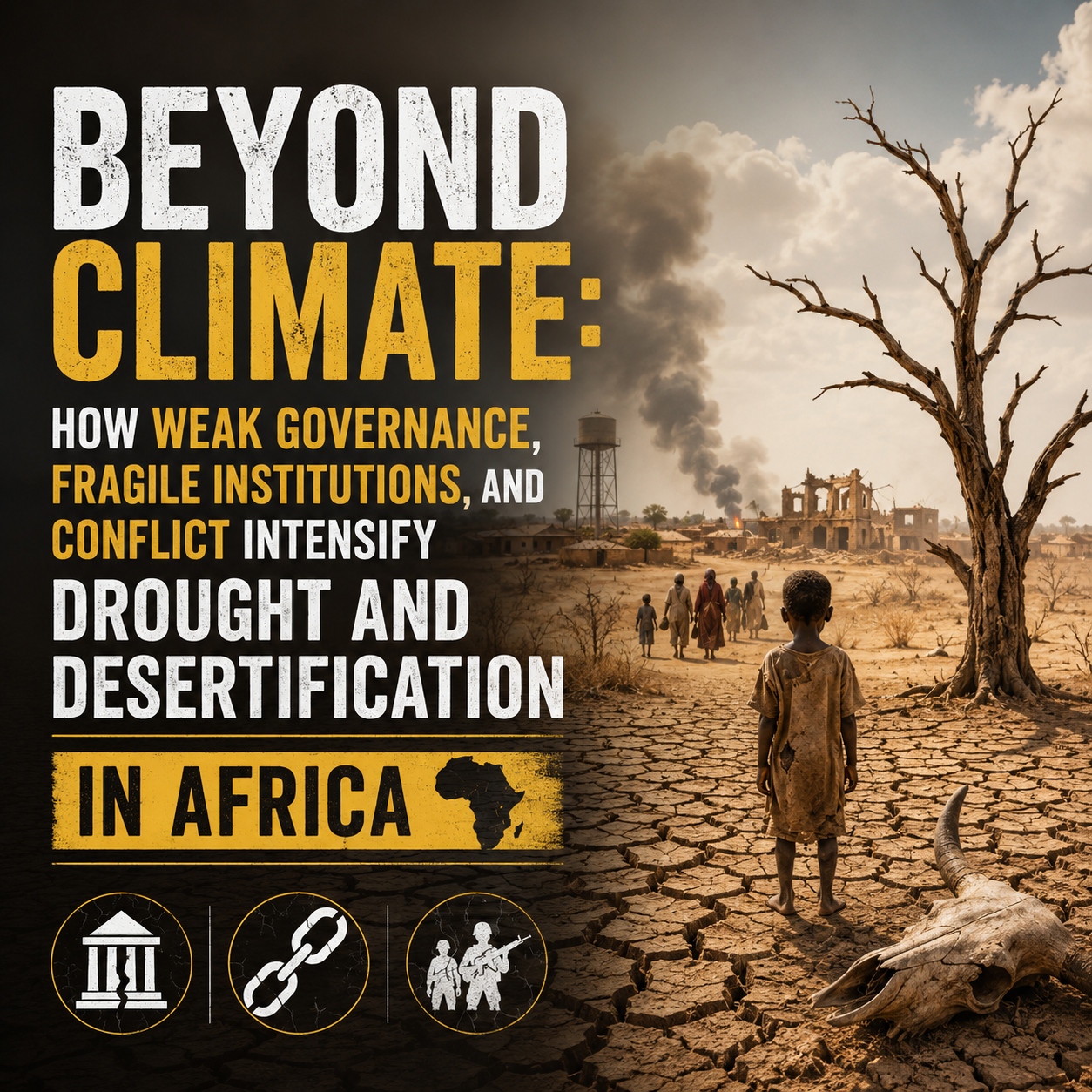
Every year on 17 June, the global community commemorates the World Day to Combat Desertification and Drought, reminding governments, institutions, and citizens that land degradation threatens food security, biodiversity, livelihoods, peace, and sustainable development.
While climate change undoubtedly accelerates drought and desertification, Africa's environmental crisis cannot be explained by climate alone. Across the continent, weak governance, fragile institutions, corruption, armed conflicts, and poor land-use planning have transformed natural climatic challenges into prolonged humanitarian and ecological disasters.
Alkebulan Society for Environmental Sustainability (AkSES) believes that good governance is one of Africa's most powerful climate adaptation tools. Countries with accountable institutions, long-term environmental planning, and effective public participation have demonstrated that drought and desertification can be slowed and even reversed despite difficult climatic conditions. Our elders remind us that "When the roots of a tree begin to decay, it spreads death to the branches."
Likewise, when governance deteriorates, environmental degradation inevitably follows.
Why Desertification Is More Than a Climate Problem
Although rising temperatures and declining rainfall contribute significantly to land degradation, they are often multiplied by human failures, including:
• Weak environmental governance.
• Poor enforcement of environmental laws.
• Corruption in natural resource management.
• Political instability.
• Armed conflict and insecurity.
• Unsustainable agricultural practices.
• Deforestation.
• Overgrazing.
• Unplanned urban expansion.
• Poor water management.
• Population displacement resulting from conflict.
These factors frequently determine whether drought becomes a manageable environmental event or a prolonged national catastrophe.
How Weak Governance Accelerates Desertification
Across many countries in Mother Africa, governance failures continue to worsen environmental degradation through:
• Weak Institutions
• Environmental agencies remain poorly funded.
• Regulations are rarely enforced.
• Land administration systems are weak.
• Environmental impact assessments are often ignored.
• Corruption
Corruption contributes directly to:
• Illegal logging.
• Encroachment into protected forests.
• Illegal mining.
• Unsustainable grazing rights.
• Politically motivated land allocation.
• Diversion of environmental funds.
• Poor Land-Use Planning
Many governments continue to permit:
• Settlement in fragile ecosystems.
• Cultivation on marginal lands.
• Destruction of wetlands.
• Construction that blocks natural drainage.
• Unsustainable expansion into forest reserves.
Conflict and Insecurity: The Silent Drivers of Desertification
Armed conflict has become one of Mother Africa's greatest environmental threats.
Conflict contributes to desertification through:
• Destruction of forests.
• Burning of vegetation.
• Abandonment of sustainable farming.
• Collapse of environmental institutions.
• Increased illegal exploitation of natural resources.
• Large-scale displacement of rural populations.
• Concentration of refugees around fragile ecosystems.
• Breakdown of local conservation initiatives.
Countries affected include: Sudan, South Sudan, Somalia, Mali, Burkina Faso, Niger, Chad, Congo DR, Nigeria, and Ethiopia.
In these regions, insecurity prevents governments, researchers, and conservation organizations from implementing long-term restoration programs. Without peace, environmental sustainability becomes difficult.
Countries Making Remarkable Progress
Some of the countries above have demonstrated that strong governance can successfully combat drought and desertification.
Rwanda has become one of Mother Africa's examples through:
• Nationwide tree-planting campaigns.
• Strict environmental law enforcement.
• Restoration of degraded hillsides.
• Community participation.
• Integrated watershed management.
• Effective land-use planning.
Ethiopia faced severe drought, but has achieved significant progress through:
• The Green Legacy Initiative.
• Massive annual tree planting.
• Watershed rehabilitation.
• Soil and water conservation.
• Community mobilization.
• Sustainable land restoration programs.
Millions of hectares of degraded land have been restored through coordinated national action.
Morocco invested heavily in:
• Modern irrigation.
• Water harvesting.
• Renewable energy.
• Sustainable agriculture.
• National adaptation strategies.
• Desert ecosystem restoration.
The country’s integrated water management approach has strengthened resilience to drought.
Botswana continues to demonstrate:
• Responsible rangeland management.
• Sustainable livestock policies.
• Protection of dryland ecosystems.
• Long-term environmental planning.
• Strong institutional coordination.
The Great Green Wall Initiative
Senegal, Mauritania, Niger, Nigeria, Ethiopia, Djibouti, Eritrea, Mali, Chad, Burkina Faso, and Sudan; as members of this Africa-led Initiative have collectively restored millions of hectares of degraded landscapes through reforestation, agroforestry, and community-based land management. While implementation has varied among participating states, the initiative demonstrates the value of regional cooperation in combating land degradation.
Countries Still Facing Major Challenges
Several countries continue to struggle because environmental governance remains undermined by institutional weakness, insecurity, and/or political instability, including;
Sudan: Ongoing conflict, massive displacement, institutional collapse, accelerated land degradation,
Somalia: Chronic drought, prolonged insecurity, weak environmental governance, and limited institutional capacity.
Chad: Rapid desert expansion, shrinking water resources, weak environmental enforcement,
Mali, Burkina Faso and Niger may have issues due to armed insurgencies, population displacement, overgrazing, and deforestation.
Nigeria: Environmental degradation is intensified mainly in Northern Nigeria due to desert encroachment, deforestation, farmer-herder conflicts, weak enforcement of environmental regulations and unsustainable fuelwood harvesting due to insecurity.
The Governance–Environment Nexus
AkSES maintains that drought resilience depends not only on rainfall but also on the quality of governance.
Countries with stronger governance generally demonstrate:
• Better environmental planning.
• Greater institutional accountability.
• Stronger rule of law.
• Improved natural resource management.
• Higher levels of public participation.
• Greater investment in restoration programs.
• Better climate adaptation.
• More effective disaster preparedness.
Conversely, weak governance often results in:
• Increased land degradation.
• Food insecurity.
• Forced migration.
• Poverty.
• Resource conflicts.
• Biodiversity loss.
• Reduced resilience to climate change.
AkSES Calls on African Governments
To build a drought-resilient Africa, AkSES calls upon governments to:
• Strengthen environmental institutions.
• Mainstream environmental sustainability into national development planning.
• Eliminate corruption in land and natural resource governance.
• Enforce environmental laws without political interference.
• Invest in sustainable agriculture.
• Restore degraded forests and watersheds.
• Expand climate-smart irrigation systems.
• Protect wetlands and fragile ecosystems.
• Secure land tenure for local communities.
• Promote indigenous environmental knowledge.
• Increase financing for ecosystem restoration.
• Strengthen early warning systems for drought.
• Support youth-led and women-led environmental initiatives.
• Integrate peacebuilding into environmental management in conflict-affected regions.
• Deepen regional cooperation through initiatives such as the Great Green Wall.
Conclusion
Desertification and drought are not merely environmental challenges, they are tests of governance, institutional strength, and political commitment.
Climate change may determine the intensity of drought, but governance often determines its consequences. The contrast between African countries making measurable progress and those trapped in cycles of environmental decline demonstrates that effective leadership, accountable institutions, and peace are indispensable for sustainable land management.
On this World Day to Combat Desertification and Drought, AkSES urges African leaders to move beyond viewing desertification solely as a climatic phenomenon. Lasting solutions require stronger institutions, transparent governance, responsible stewardship of natural resources, and an unwavering commitment to peace and environmental justice.
Africa possesses the knowledge, the people, and the natural resources needed to restore Mother Africa’s degraded landscapes. What is required now is the political will to transform environmental governance into a cornerstone of sustainable development. Again, our elders remind us that "The Earth is not ours; it is a treasure we hold in trust for generations yet unborn."
Protecting that trust demands that Africa confront not only the changing climate but also the governance deficits that too often magnify its impacts.
Geoffrey Obinna Anoliefo, Ph.D
AkSES
alkebulansustainability.org